


About this series: This post is part of a joint content series from The Rideshare Guy and Solo, pairing The Rideshare Guy's driver expertise with Solo's anonymized earnings data from millions of gig workers.
TL;DR
Across 15 major US metros, a typical Uber driver needs about 28 to 52 hours of on-trip time to gross $1,000 in a week. A typical Lyft driver needs about 33 to 66 hours.
Seattle is fastest at 27.6 hours on Uber and 33.3 on Lyft, thanks to Washington's rideshare minimum pay standards. Houston and Miami are the slowest.
Uber paid more than Lyft in every metro. After estimated vehicle costs, $1,000 takes about 54 hours on Uber and 71 on Lyft, before taxes.
Across 15 major US metros, a typical Uber driver needs about 28 to 52 hours of paid driving time to gross $1,000 in a week. A typical Lyft driver needs about 33 to 66 hours. Where you live and which app you drive for can swing your week by more than 20 hours.
That's based on earnings data from thousands of rideshare drivers who use Solo to track their income, covering September 2025 through August 2026. All figures include tips and bonuses.
Which cities get you to $1,000 fastest?
What stands out
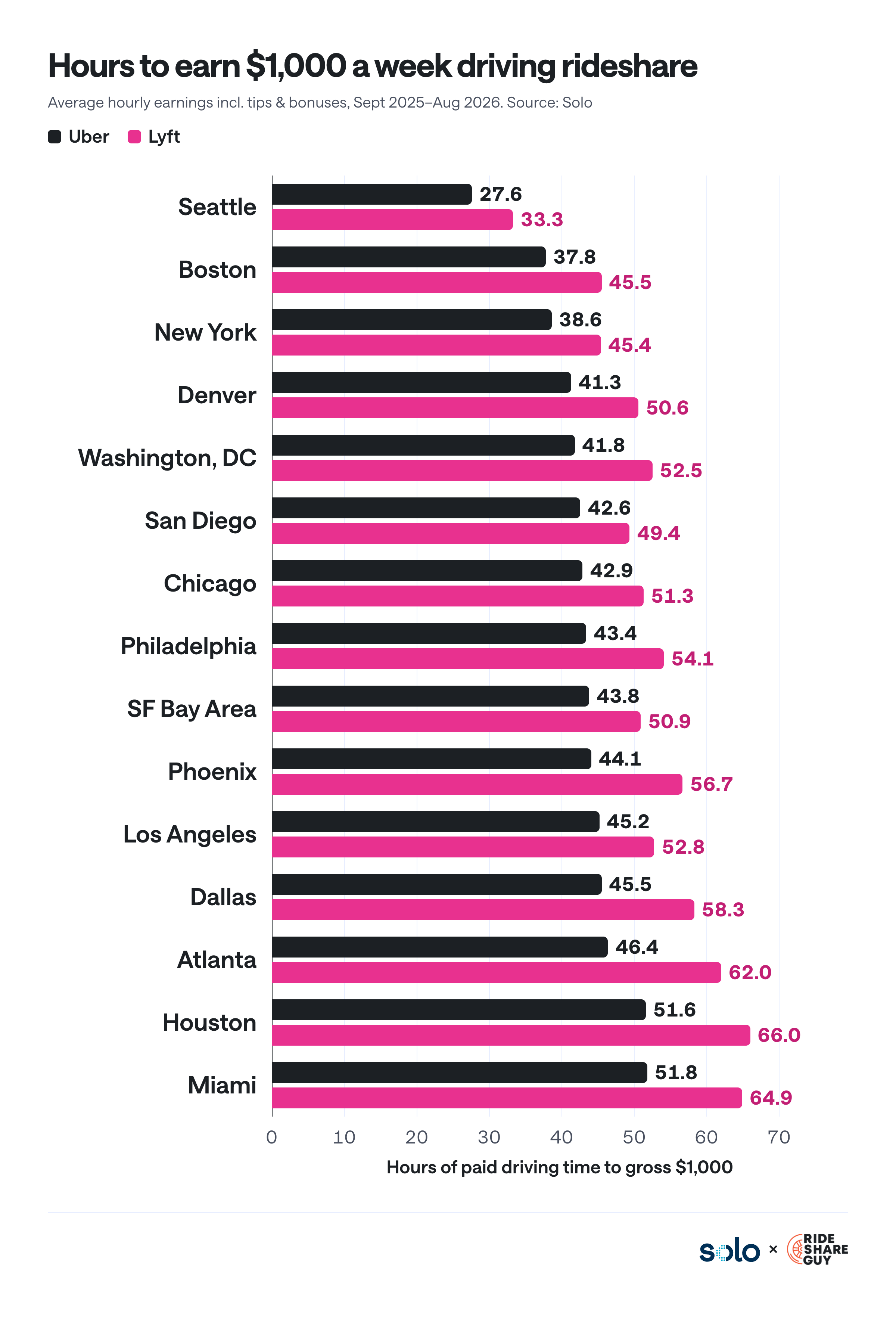
Seattle is in a league of its own. With an average of $36.28 an hour on Uber and $30.06 on Lyft, Seattle drivers reach $1,000 in about 28 hours of trip time on Uber and 33 on Lyft. That's roughly ten hours faster than any other metro. The difference reflects Seattle and Washington State's minimum pay standards for rideshare drivers.
Boston and New York round out the top three. Both have Uber averages above $25 an hour, which gets drivers to $1,000 in under 39 hours of trip time.
Houston and Miami are the slowest. Both sit below $20 an hour on Uber and around $15 on Lyft. A Lyft-only driver in Houston needs roughly 66 hours of trip time to reach $1,000. That's about twice as long as a Lyft driver in Seattle.
Uber paid more than Lyft in every single metro. The gap matters most in the Sun Belt. In Atlanta, a Lyft-only driver needs about 15½ more hours than an Uber-only driver to reach the same $1,000. In Houston it's about 14½ more hours, and in Miami about 13. The gap is narrowest in Seattle, at under 6 hours, followed by San Diego and New York at about 7.
The hours you don't see
These numbers count only time spent on trips. They don't include time waiting for requests, driving to pickups, or repositioning between rides. So if the table says 45 hours, expect your time logged into the app to be higher. How much higher depends on your market, the time of day, and how selective you are with requests. You can use Solo's Smart Schedule and Sherpa AI to optimize your schedule and minimize downtime in your city.
What about after expenses?
Gross isn't take-home. Across Solo's drivers, the typical Uber driver earns $22.37 an hour gross and about $18.47 after estimated vehicle costs. For Lyft, it's $18.29 gross and about $14.13 net. At those net rates, clearing $1,000 after vehicle costs takes roughly 54 hours of trip time on Uber and 71 on Lyft, and that's before taxes.
The catch is that most drivers don't know their real cost per mile, or what they're owed at tax time. That's where Sherpa, Solo's AI copilot, comes in. Sherpa automatically tracks your mileage and expenses as you drive, so you can see what you're actually taking home, not just what the app pays you. Come tax season, every deductible mile and expense is already logged.
How to reach $1,000 in fewer hours
The drivers who hit their weekly targets fastest tend to do a few things. They drive for the higher-paying app in their market, or run both at once to cut down on idle time. They concentrate their hours on the busiest parts of the week. And they track earnings per hour, not just per trip, so they know when it's worth logging off. Solo pulls your earnings from every app you drive for into one place, so you can see your real hourly rate instead of guessing.
Know your real hourly rate
Solo pulls your earnings from Uber, Lyft and every other app into one place, logs your miles automatically, and shows what you actually take home after costs.
Frequently asked questions
How many hours does it take to make $1,000 a week driving for Uber?
About 28 to 52 hours of paid on-trip time, depending on the metro. Seattle is fastest at 27.6 hours, and Miami is slowest at 51.8 hours, based on Solo earnings data from September 2025 through August 2026.
How many hours does it take to make $1,000 a week driving for Lyft?
About 33 to 66 hours of paid on-trip time. Seattle is fastest at 33.3 hours, and Houston is slowest at 66.0 hours.
How many hours does it take to make $1,000 a week after vehicle costs?
Roughly 54 hours of trip time on Uber and 71 on Lyft, based on average net earnings of about $18.47 and $14.13 an hour after estimated vehicle costs. That's before taxes.


.jpg)
